A question I get from business owners almost every week:
"Should I do Six Sigma, or Lean, or EOS, or hire a coach, or …"
My answer never changes.
You are asking the wrong question.
All of those frameworks are useful. Some are excellent. But most business owners I meet are reaching for them too early, before they have the one thing that makes any of them actually work. And that thing isn't a methodology.
It is a baseline. A documented, repeatable, "this is how we do things here" version of your business that your team actually follows.
Without that, every methodology you pick up is trying to improve a business that doesn't quite exist.
This article is my attempt to place SYSTEMology on the map for you. Not as a competitor to Six Sigma or Lean or EOS or your business coach, but as the foundation layer that makes all of them work.
The order that matters
There are really two jobs you can do on a business.
Job one: capture what you already do. Get the baseline working. Document the processes. Make sure anyone on the team can run the work to a predictable standard.
Job two: improve what you already do. Take that baseline and make it better. Reduce waste. Cut variation. Eliminate bottlenecks. Align the leadership team on where to aim next.
The methodologies and frameworks you have heard of — Six Sigma, Lean, Theory of Constraints, Kaizen, EOS, business coaches — almost all live in job two.
SYSTEMology lives in job one.
You cannot improve a baseline you do not have. So before any of those other methodologies can do what they do best, the baseline has to be in place. That is where SYSTEMology sits.
Let me walk you through the ecosystem and show you where each methodology fits, and in what order.
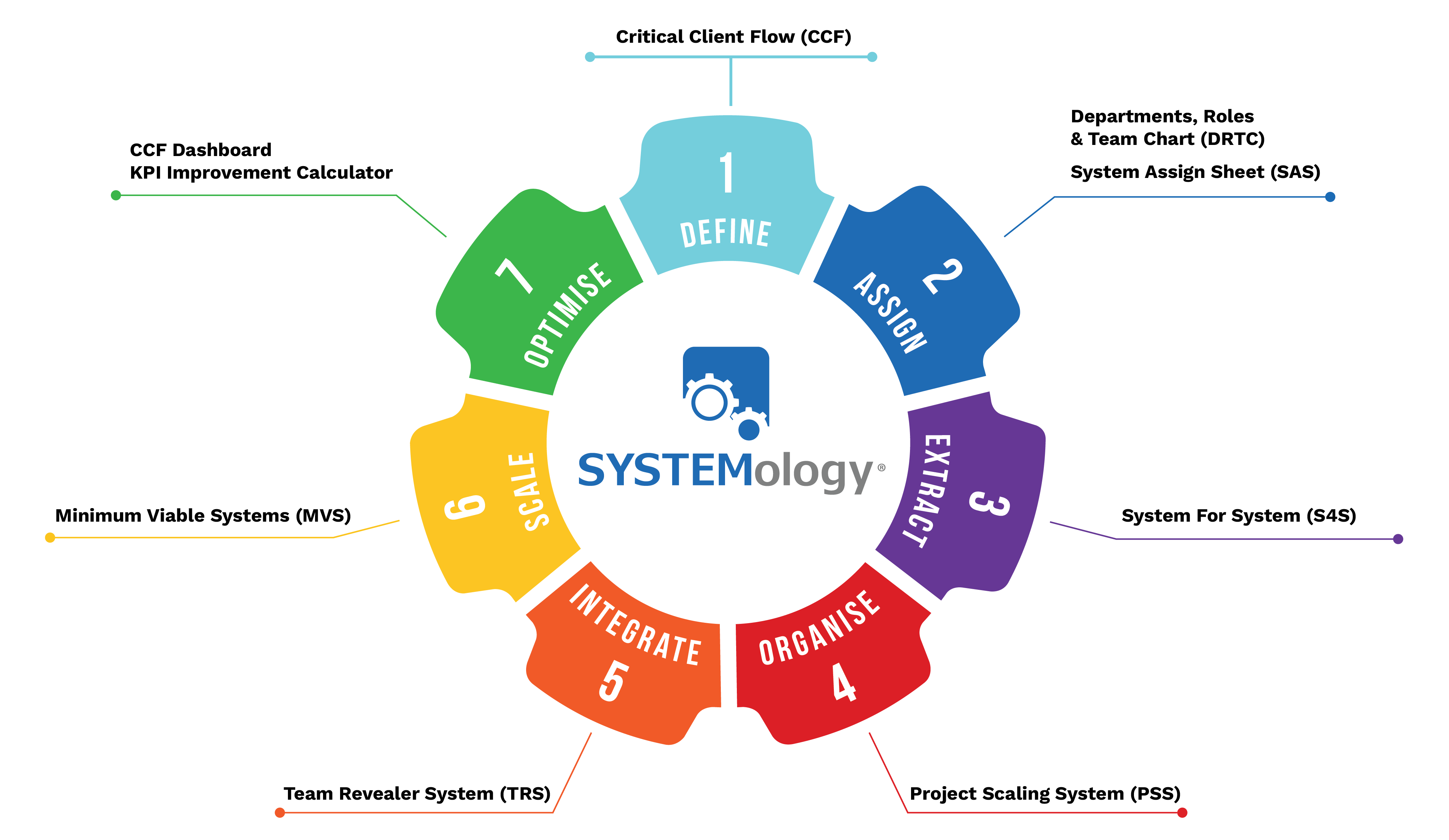
SYSTEMology vs Six Sigma
Six Sigma is about reducing variation. Born at Motorola in the 1980s, made famous by Jack Welch at GE in the 1990s, it is a statistical methodology for driving defects out of a process until the process performs with near-perfect consistency.
Powerful stuff. Wrong stuff for most small businesses on day one.
The reason is that Six Sigma assumes you already have a documented process producing measurable output. A yield. A defect rate. A consistent baseline it can statistically analyse. If you are still at "sometimes Susan does it this way and sometimes Mark does it a different way and the outcome varies", you have nothing for Six Sigma to reduce.
SYSTEMology captures how Susan and Mark should be doing it. Six Sigma then takes that documented process and drives the variation in the output down toward zero.
The order is: document first (SYSTEMology), then reduce variation (Six Sigma). If you are in manufacturing, medical, or any complex process where consistency genuinely matters to the customer, Six Sigma is a powerful second-stage tool. For most service businesses, the SYSTEMology baseline is 80% of the prize on its own.
For a deeper look at when Six Sigma does and does not fit a small business, my article on Six Sigma for small business walks through it.
SYSTEMology vs Lean
Lean came out of Toyota. Where Six Sigma is about variation, Lean is about waste.
The Toyota Production System identified eight kinds of waste that creep into any process — overproduction, waiting, transport, overprocessing, inventory, motion, defects, and unused talent. Lean is the disciplined practice of identifying and eliminating those.
Great methodology. Same prerequisite as Six Sigma.
You cannot spot waste in a process that nobody agrees on. If your sales team has three versions of how they follow up, you do not have a waste problem. You have a baseline problem. Lean applied to chaos just creates three different kinds of lean chaos.
SYSTEMology documents the baseline. Lean then takes that documented baseline and starts asking, "which of these steps do not add value to the customer?" The waste falls out quickly once the process is visible to everyone.
The order is: document first (SYSTEMology), then strip waste (Lean). A systemised business that adopts Lean thinking becomes ruthlessly efficient. An unsystemised business that tries Lean just ends up with faster chaos or, more commonly, a failed initiative.
SYSTEMology vs Theory of Constraints
Theory of Constraints, from Eliyahu Goldratt's book The Goal, is elegantly simple. Every process has a bottleneck. The only way to increase throughput is to find and fix that bottleneck. Anything else you do is fake progress.
I love Theory of Constraints. It is one of the most underused frameworks in small business. But it has the same prerequisite as the other two methodologies.
To find your bottleneck, you have to be able to see the end-to-end flow of your work. If your process is different every time, there is no bottleneck to find. There are just different sources of frustration depending on who happens to be doing the work that day.
Once SYSTEMology has mapped your Critical Client Flow — the 10 to 15 steps that take a prospect from first contact to happy, repeat customer — Theory of Constraints becomes extraordinarily powerful. Now you can see which step is slowing everything down, fix it, and watch the whole business accelerate.
The order is: document the flow (SYSTEMology), then find and fix the bottleneck (TOC). For more on this, see my article on Theory of Constraints for small business.
SYSTEMology vs Kaizen
Kaizen is the cultural cousin of Lean. The Japanese word means "change for the better" and, as a business practice, it is the habit of continuous, small, daily improvements to how the work gets done.
Of all the improvement frameworks, Kaizen is the one that pairs most naturally with SYSTEMology. Once you have a baseline, the Kaizen habit is how you make the baseline a little bit better every week.
But notice the order again. Kaizen without a baseline is just changing things.
I have written a longer piece on this at Kaizen for small business. The short version: SYSTEMology gets you the baseline, Kaizen keeps making the baseline better.
SYSTEMology vs EOS
This is the comparison I get asked about most often.
The Entrepreneurial Operating System (EOS), from Gino Wickman's book Traction, is a strategic operating system for the leadership team. It helps owners and leadership teams get clear on vision, set quarterly rocks, run effective meetings, resolve issues, and hold people accountable.
EOS and SYSTEMology are not competitors.
They operate at completely different layers.
EOS is the leadership operating system. Vision, people, data, issues, process, traction. It answers questions like "what are we building?" and "who owns which outcomes?" and "are we making progress on the rocks?"
SYSTEMology is the operational operating system underneath. It answers questions like "how does the actual work get done, consistently, by whoever is on shift today?"
Plenty of our clients run both. EOS at the leadership table, SYSTEMology in the workflow. They stack together beautifully. The leadership team uses EOS to align on direction. The operations team uses SYSTEMology to execute with consistency. The two methodologies touch each other at "Process" (the fifth EOS component), which is SYSTEMology's entire home.
If you are choosing between them, do not. Ask instead: is my problem leadership alignment, or is it operational inconsistency? EOS is the answer for the first. SYSTEMology is the answer for the second.
SYSTEMology vs a business coach
I work with a lot of business coaches. Many of them are wonderful. Many of my own clients have a coach alongside their SYSTEMology engagement.
Here is the honest way I frame this one to business owners.
A coach gives you three things: accountability, outside perspective, and strategic input. They meet with you weekly or monthly. They ask questions that make you think. They hold you to commitments you would otherwise quietly let slide.
All three are valuable. None of them replace having a business that can run without you.
What a coach cannot do is document your specific processes, train your team on them, or build the culture that makes systems stick. Those are not coaching problems. They are implementation problems. A coach can point you at them, but the work has to happen inside your business, week after week.
If you have the budget for both, the best sequence I have seen is: SYSTEMology for the operational foundation, a coach for the strategic layer on top. The two amplify each other. Without SYSTEMology, most coaching conversations circle the same question — "why is everything still on your plate?" — because the answer never gets solved.
The right sequence
Put all of this together and the sequence looks like this.
Step 1: SYSTEMology. Document your Minimum Viable Systems. Get the team following them consistently. Build the culture where systems thinking is just how we do things here.
This is not a weekend project. It is a 90-day rollout if done properly. My article on how to systemise your business walks through the plan. The full framework behind how to sustain this lives in the Three Pillars at three-pillars-systemised-business.
Step 2: Kaizen. Build the habit of small, weekly improvements. Your Systems Champion runs this. Five minutes a week of "what was slow or frustrating this week, and what is the smallest improvement we can make?"
Step 3: Theory of Constraints. Find your bottleneck. Fix it. Find the next one. Fix that. Throughput rises predictably.
Step 4: Lean. When you have basic flow working, start stripping waste. Which steps do not add value to the customer? Which handoffs are slower than they need to be?
Step 5: Six Sigma, if you need it. For critical processes where consistency is the product — manufacturing, healthcare, certain service businesses — drive variation down.
EOS and a coach sit parallel to this stack, not inside it.
EOS runs the leadership team's operating system regardless of where the operations are in their journey. A coach gives you accountability and perspective at whichever stage you are at.
Most businesses that "fail at systems" are actually running this stack backwards. They start with Lean or Six Sigma on processes that have never been documented. Or they hire a coach and expect the coach to systemise the business for them. Or they adopt EOS and wonder why the team is still dependent on the owner for every decision. Different problem, different tool, wrong order.
Where we differ from the rest
Here is the thing I have noticed most about the frameworks in this comparison.
They are all fantastic at improving what already exists.
They are all poor at capturing what does not exist yet.
SYSTEMology exists because I spent 15 years running my own digital agency trying every one of these methodologies. I went to the Lean workshops. I read the Six Sigma books. I hired the coaches. I ran EOS at the leadership table. None of them, on their own, got my business out from under my shoulders.
What finally worked was a dedicated approach to capturing the baseline — the specific Critical Client Flow of my business, documented in a form my team could actually follow, backed by a Systems Champion who owned the ongoing work.
Once that was in place, every other methodology I had ever studied suddenly became useful.
That is the story behind SYSTEMology. And it is why, when business owners ask me "should I do Six Sigma, Lean, EOS, or hire a coach?", my answer is always: yes, eventually, once your baseline is in place.
The bottom line
You are not choosing between SYSTEMology and those other methodologies.
You are choosing the order.
Document first. Improve later. Without the baseline, improvement frameworks have nothing to improve. With the baseline, every methodology on this page becomes a legitimate force multiplier.
If you want to see how to set up the foundation properly, start with the Three Pillars framework or how to systemise your business in 90 days. If you want to see how SYSTEMology sits alongside different business improvement methods in a bit more depth, that piece covers the Kaizen/Lean/TOC/Six Sigma side in detail.
Ready to build the foundation the other methodologies actually need? systemHUB gives you a place to document your systems, train your team on them, and keep them current — loaded with 100+ SYSTEMology templates to get you moving. Try it free.