ChatGPT hit a million users in five days.
Netflix took three and a half years to pull off the same feat. Facebook took 10 months. Instagram took two and a half. The fastest consumer technology rollout in human history is happening right now, inside your clients' inboxes and your competitors' back offices.
And most business owners are watching it like Blockbuster watched Netflix.
In 2000, Blockbuster had 9,000 stores and the chance to buy Netflix for $50 million. They laughed it off. By the time they realised streaming was the future, it was too late.
The AI revolution is not happening over years. It is happening over weeks. And the businesses that will win in this new era are not the ones with the best technology. They are the ones with a dedicated person making AI actually useful.
That person is your AI Champion.
Learn more →
What is an AI Champion?
An AI Champion is the dedicated person inside your business who turns documented systems into AI-powered workflows.
They are not an IT person. They are not a developer. They are not a consultant who shows up for a workshop and disappears. They are a permanent member of your team whose job is to know how your business runs, spot where AI can add real value, build the prompts and automations that capture that value, and bring everyone along with them.
Think of them as the bridge between two things most businesses cannot connect: the documented knowledge of how your work actually gets done, and the rapidly-evolving capabilities of modern AI tools.
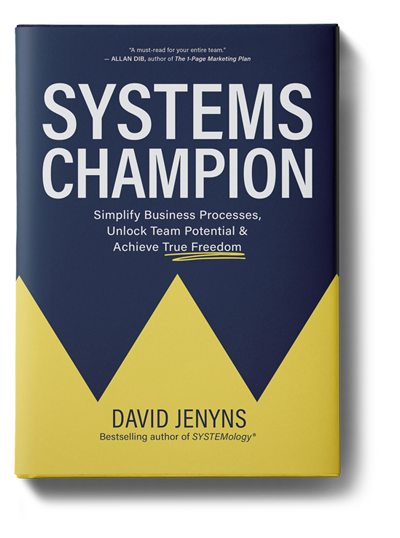
In my latest book, Systems Champion, I argue that this role is about to become one of the most important hires any growing business will make. Not because AI is going to replace people, but because it will redefine what people are able to do.
The difference between a Systems Champion and an AI Champion
If you have read my work before, you know I am a huge believer in the role of the Systems Champion. The person who owns the documentation of your business processes. The first follower who turns systemisation from a solo act by the owner into a cultural movement.
So how does the AI Champion differ?
Honestly, they do not. Not really.
The AI Champion is the natural evolution of the Systems Champion role. A Systems Champion answers the question "how do we do this work?" An AI Champion answers the question "how much of this work can AI do for us?"
They are the same mindset pointed at two different problems. And the reason the evolution is natural is because AI needs what a Systems Champion already has: documented processes. Clear instructions. A mental map of how the business actually runs.
Without documentation, AI is guessing. With documentation, AI is a power multiplier for every role in the company.
In practice, in a small or mid-sized business, one person grows into both roles. They start as a Systems Champion, documenting the Critical Client Flow and the Minimum Viable Systems. As that foundation matures, they start experimenting with AI inside those systems. Six months in, they are your AI Champion too.
This is why I often describe the role as "Systems and AI Champion."
Why every business needs one
The AI tools themselves are not the hard part.
You can sign up for ChatGPT, Claude, or any number of specialist tools in about 90 seconds. The cost is trivial. The learning curve is shallower than any software wave we have seen before. None of this is hard.
The hard part is knowing where to point them. And that is where most businesses get stuck.
AI handed to a busy owner becomes another tab they never open. AI handed to a team without guidance becomes a novelty that gets forgotten within three weeks. I have watched dozens of businesses buy into the AI hype, try to "just let the team use it", and see nothing change six months later.
The missing piece is always the same.
Someone needs to own this. Not as a side project. As a role.
That person needs the time and mandate to learn the tools, understand where your specific business can benefit, build the first few AI-powered workflows, teach the team how to use them, and keep the whole thing moving as the tools evolve.
Without that person, AI becomes the fitness app you bought in January. With that person, AI becomes a compounding advantage that your competitors cannot easily match.
What an AI Champion actually does
The AI Champion role is practical. Four jobs sit at the centre of it.
Spot where AI adds the most value. Not everywhere, not yet. The AI Champion walks the business, talks to each team, and finds the highest-leverage opportunities. Places where work is tedious, writing-heavy, repetitive, or bottlenecked by a single person. These are the candidates for the first wave of AI automations.
Build the prompts, assistants, and automations. This is the craft of the role. Taking a documented process and turning it into a workable AI tool. Writing the prompt that turns a video recording of a meeting into a structured set of action items. Creating the assistant that drafts first-pass customer service replies. Building the workflow that summarises the week's sales calls into a coaching report automatically.
Teach the team how to use what they build. A tool nobody uses delivers nothing. The AI Champion runs short training sessions. Shares wins in team chat. Answers the "how do I use this for X?" questions. Their job is not just to build the tools but to make them the path of least resistance for every team member.
Keep the whole thing current. AI capabilities change every few weeks. What was best practice in January is obsolete by June. The AI Champion is the person whose job is to stay on top of the changes, test new tools, and upgrade the existing workflows as better options appear.
None of this is rocket science. All of it takes dedicated time.
AI as a data refinery
There is an analogy I like when people ask me what AI is actually good at.
Think of AI as a modern-day oil refinery. A refinery takes crude oil — raw, messy, unusable in its current form — and transforms it into valuable products. Gasoline. Plastics. Lubricants. Products that power the entire economy.
AI does the same thing with data.
Your business is sitting on an oil field. Every customer interaction, every support ticket, every sales call, every documented process is crude. In its current form, most of it sits in folders, email threads, and Zoom recordings that nobody ever looks at again.
The AI Champion is the refinery operator.
They take your raw data — your SOPs, your call recordings, your client conversations, your internal documents — and turn it into actionable value. Patterns emerge. Insights surface. Routine work gets handled automatically while your humans focus on the things that humans actually do best.
But the refinery only works if the crude oil is there. That is why process and documentation come first. For the full argument on why you should never skip this step, my article on process first, then AI walks through it.
Skills to look for in an AI Champion
The good news about this role is that the skills are not technical. You are not hiring a data scientist.
Here is what I look for.
Curiosity. The best AI Champions are the team members who are already playing with ChatGPT on the weekend. They read newsletters. They try the new features. They ask "I wonder if AI could do this?" about their own job, without being asked.
Detail orientation. Same as the Systems Champion profile. Someone who notices when things are inconsistent. Who cares about getting the prompt right. Who will not settle for "it sort of works" when "it actually works" is possible.
Clear communication. They will be teaching your team, writing documentation, and explaining AI outputs to people who do not know how it works. Shy engineers need not apply. You want someone who can translate between the business side and the AI side.
Comfort with change. AI capabilities change fast. Your AI Champion has to enjoy that. If new software gives them anxiety, this is not their role.
Deep business knowledge. This is the killer criterion. The AI Champion needs to know how your business actually runs from end to end. What the customer cares about. Where the friction is. Which processes are sacred and which are free to be rewritten.
That last one is why you should almost always promote an AI Champion rather than hiring externally.
Promote, don't hire
When owners first hear about the AI Champion role, they often reach for the job board.
Don't. Look at your own team first.
The AI Champion's biggest asset is not their technical knowledge. It is their understanding of how your business works. That understanding takes months or years to build. An external hire starts from scratch. An internal promotion starts with a deep map of the whole business.
Consider Eryn from Stannard Homes. She started at the business doing interior design. By nature she was curious about everything, so when systems became a priority, she got involved in documenting them. Across departments. Across workflows. She ended up with a rare asset: a complete view of how a $15-$20 million construction business actually ran.
When AI entered the picture, who do you think was best placed to decide where it should be applied?
Ryan, the owner, is now mentoring Eryn to run the whole operation while he launches a new venture. That is the arc the right AI Champion can unlock. Not just a faster team, but a more valuable business.
Look around your own business. Who already has that kind of curiosity and breadth? They are probably the person who keeps suggesting process improvements that nobody has time to implement. Give them the time. You have found your AI Champion.
Where to start
The mistake I see most new AI Champions make is trying to build their most ambitious project first.
They want to automate the entire sales pipeline, or build a chatbot that can handle every customer question, or create a digital clone of the best sales rep on the team. Big swings, all of them. All of them will fail.
The right approach is small and practical.
Start with three low-risk, high-obvious-value wins.
AI-assisted documentation. This is my number one starting point. Record someone explaining how they do a process on video, drop the recording into an AI tool, and get 80-90% of the documentation drafted in minutes. What used to take hours of transcription and rewriting now takes 20.
Customer service drafts. Train an AI assistant on your best customer service replies and your current FAQ. Have it draft first responses to every incoming inquiry. Humans review and edit. Response time drops. Quality stays high. Your team stops dreading the inbox on Monday mornings.
Meeting summaries. Sales calls, client meetings, internal planning. Every one of them produces a recording or transcript that sits unused. An AI summariser can pull the key points, action items, and next steps into a shared format the team actually reads. This alone recovers hours each week.
Each of these is measurable. Each delivers value within a week. Each builds credibility and momentum for the bigger projects to come.
Do not try to boil the ocean. Start with a cup of tea.
Creating AI-powered team members
Once you have the basics running, the AI Champion's work shifts from "use AI as a tool" to something bigger. Building AI-powered team members. Not replacements for your people. Specialist assistants that augment them.
Imagine a customer-service AI trained on every support ticket you have ever answered, every refund decision you have ever made, every difficult conversation you have ever resolved well. It drafts replies. Your humans review. The team moves three times faster without losing quality.
Imagine a sales AI trained on every pricing conversation, every objection, every closed-won deal. It prepares your reps before calls. Flags common pitfalls. Drafts follow-up emails.
Imagine an operations AI trained on every documented workflow, every recurring client issue, every supply chain decision. It spots delays early. Suggests fixes. Keeps the delivery machine running.
None of this is futuristic. Businesses are doing it today.
The bottleneck is never the AI. The bottleneck is having someone whose job it is to build these tools. An AI Champion.
The urgency problem
Here is what worries me when I talk to business owners who are "waiting to see how AI plays out."
The gap is widening fast.
Businesses with an AI Champion are running measurably faster than businesses without one. Better customer response times. Lower cost per task. More output per team member. These are not edge cases; they are starting to be the new baseline.
If you do not have an AI Champion in 12 months, you are not behind because you chose not to adopt AI. You are behind because your competitors adopted it earlier, more thoroughly, and with better execution. By the time you catch up, they will have compounding advantages you cannot close.
This is not hype. This is what the internet revolution looked like in 1997. It is what cloud computing looked like in 2010. And it is moving faster than either of those did.
Appointing an AI Champion is not expensive. It does not require a tech background or a huge training budget. It requires a decision, a dedicated person, and the mandate to make it work.
The bottom line
AI is not a tool.
It is a general-purpose technology. Which means every department, every process, every role in your business is about to be touched by it. The businesses that handle that transition well will compound advantages over the next decade. The ones that do not will become the next Blockbuster reference.
The difference between those two outcomes is rarely the technology itself. It is whether you have a person dedicated to making it work. Someone who knows how your business actually runs. Someone curious enough to learn the tools. Someone with the mandate to build, teach, and keep adapting.
That person is your AI Champion.
Promote from within. Start small. Build on the foundation of documented systems.
If you have not yet got those documented systems in place, start with the Three Pillars framework. If you are deciding who inside your team fits the role, my article on what a Systems Champion is lays out the profile. And if you want the full playbook, including the 90-day action plan and the deeper material on how to build AI into each of the three pillars, it is all inside my book Systems Champion.
Ready to give your AI Champion a home for the systems they will build on? systemHUB gives you a single source of truth for every documented process in the business, built to be read by humans and trained on by AI. Try it free.